Plantation shutters are the better choice on street-facing windows, hot west rooms, and anywhere you want the treatment to read as part of the house; custom blinds are the better choice when window count or budget is driving the project, or when you need something easy to replace later. Most of the houses we measure in the San Fernando and Conejo Valleys end up with a mix — shutters on the front and the rooms that cook, blinds or shades on secondary bedrooms, baths and back-of-house glass.
What you are actually choosing between in a Valley house
Both products are louvers in a frame. The difference is whether the frame is fixed to your window or hanging from a headrail.
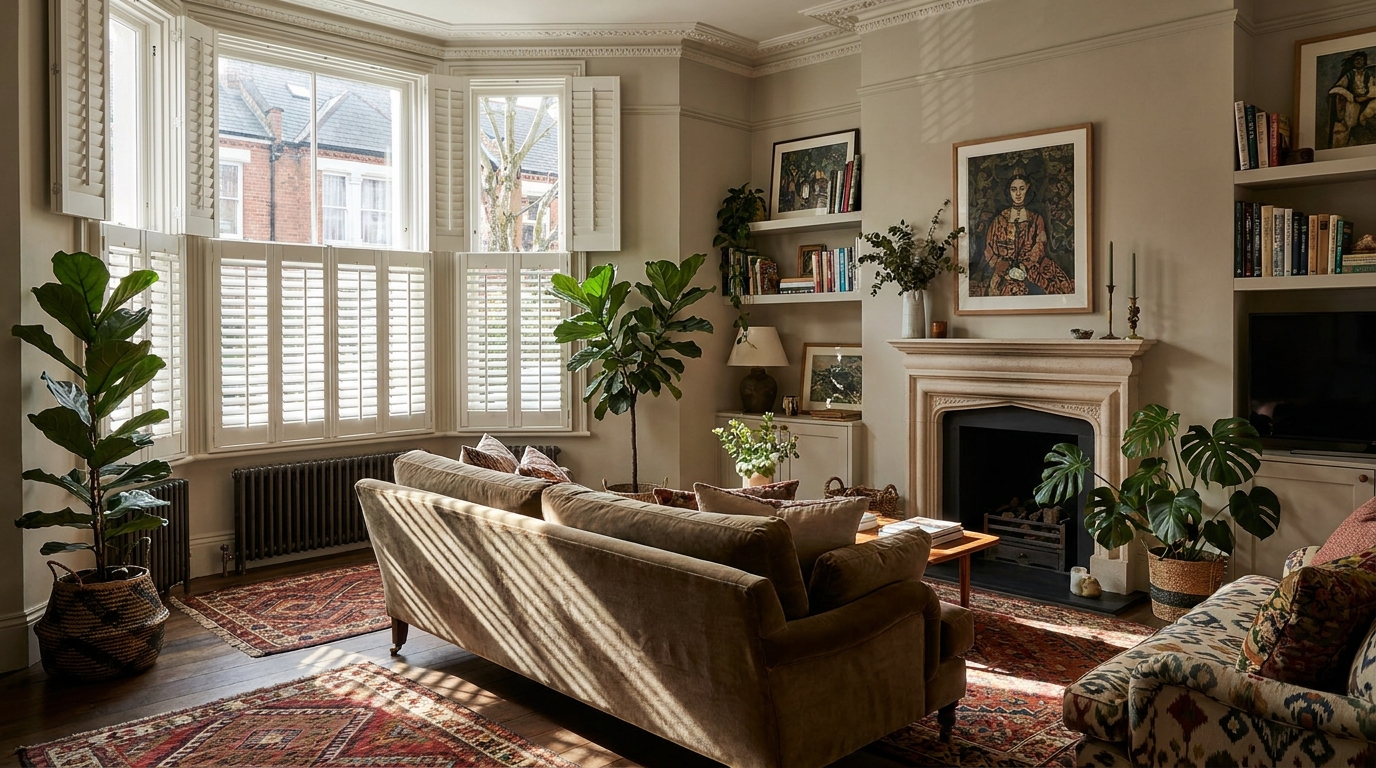
A plantation shutter is a rigid panel — solid basswood (a real hardwood) or a poly composite — hung on hinges inside a frame that is screwed or glued into the window opening. Louvers usually run 2 1/2, 3 1/2, or 4 1/2 inches. Once it is in, it is a piece of millwork. It does not come down when you move.
A custom blind is a stack of horizontal slats, typically 2 inch faux wood or 2 to 2 1/2 inch basswood, hung from a headrail with a tilt mechanism and a lift system. It raises out of the way entirely, which a shutter cannot do.
That structural difference drives almost everything else, and it lands differently depending on what you own. The 1950s through 1970s ranch stock in Northridge, Granada Hills, Encino and Tarzana tends to have wide, low windows — six or eight feet across, three or four feet tall, often original aluminum frames with shallow or no returns. Wide and short is expensive territory for shutters, because you need multiple panels and a T-post or the panels sag, and it is easy territory for a blind, which spans the width on one headrail.
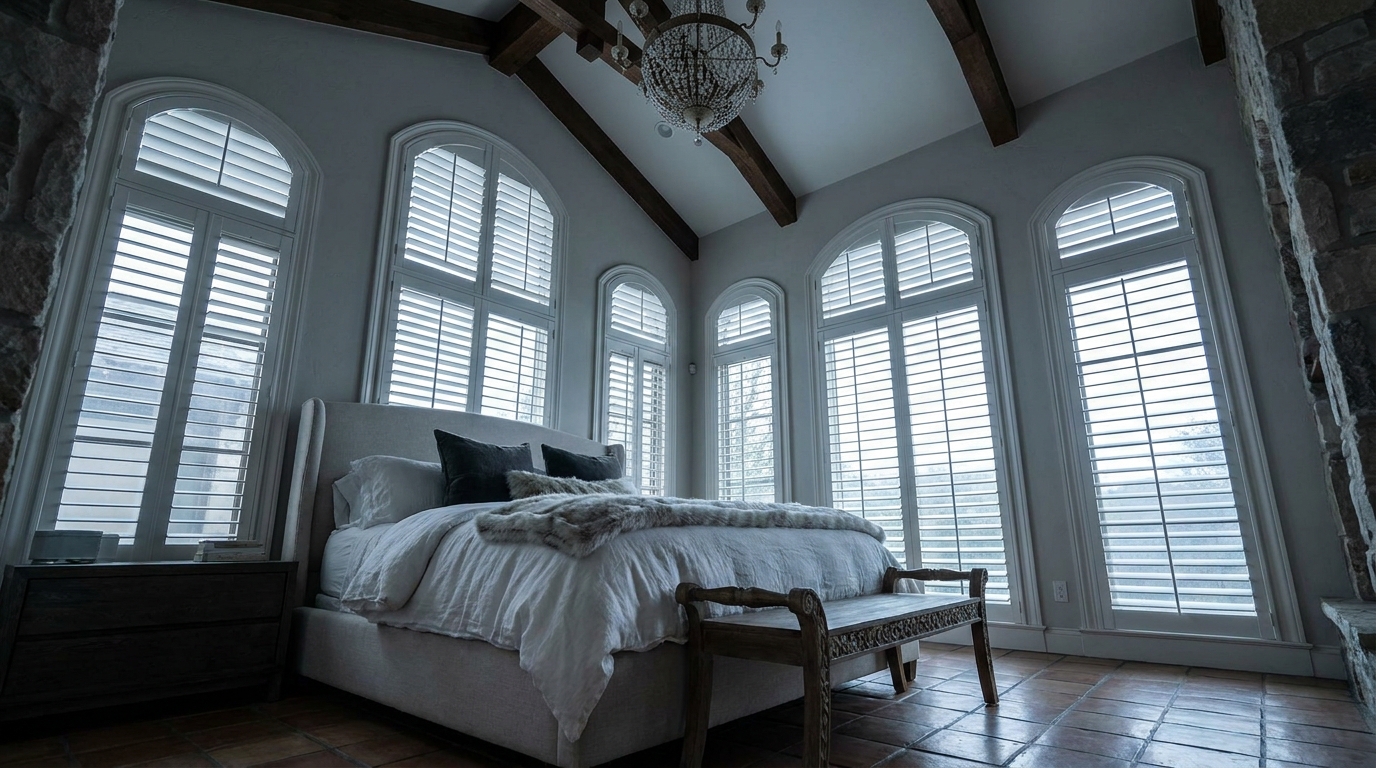
The newer gated hillside product in The Oaks in Calabasas, Hidden Hills, Bell Canyon and the Porter Ranch tracts is the opposite: tall punched openings, arched transoms, two-story great room view walls, deep drywall returns. Deep returns give a shutter frame something to land in, and tall openings let a shutter look like architecture instead of a window covering.
In San Fernando Valley? Get a free quote from a local installer
Send us your window sizes and a few photos and we'll quote you, usually the same day. Want us to come out with samples and measure? The consultation is free. Call or text us three days and times that work.
Serving Calabasas, Hidden Hills, Woodland Hills, Encino, Tarzana and nearby.
Light control, privacy and blackout: where they actually differ
On daytime light control, shutters and blinds are closer than most showrooms admit. Both tilt. Both let you aim light at the ceiling or the floor.
Three real differences:
- Closure quality. A shutter louver closes against its neighbor with a rabbeted edge inside a frame that semi-seals the perimeter. A blind slat closes with a route hole and a ladder cord running through it, so there are light gaps down every cord line and a bigger gap all the way around the headrail. Closed shutters are meaningfully darker than closed blinds. Neither is blackout.
- Zoning. Shutters can be built with a dividing rail so the top half and bottom half tilt independently. On a Studio City or Toluca Lake street where the neighbor's second story looks straight at your bedroom, that lets you close the bottom for privacy and leave the top open for light all day. A blind can only be raised from the bottom up, or bought as a top-down/bottom-up cellular, which is a different product.
- Getting out of the way. A blind stacks to a few inches at the top and gives you the whole opening. Shutter panels swing into the room and always occupy the frame. On a slider you walk through daily, that matters more than people expect.
If genuine bedroom blackout is the goal, neither one gets you there alone. That is a blackout roller or a light-blocking cellular in a side channel, or a lined drapery panel over whatever else you have.
Heat, glare and the 4pm west window
In the inland valleys this is the question behind the question. A closed shutter panel is thicker and denser than a slat, and the frame traps a pocket of still air against the glass, so on heat it beats a blind — as long as it is closed, which is the whole catch. Most people tilt rather than close, and a tilted louver on a low western sun passes a lot of light straight down the barrel.
Faux wood blinds have a specific failure mode here. A PVC or composite slat behind six feet of west glass in Woodland Hills in August gets hot, and long spans will bow and take a permanent curve. Basswood holds shape better but can warp with moisture and fade unevenly. If you want a blind on a big hot window, keep spans reasonable and expect the slats to be a wear item.
On pure heat gain, neither one is the top performer — a tight-fitting solar or cellular shade usually is. We went deep on that tradeoff in our piece on shutters and San Fernando Valley summer heat. The short version: interior treatments manage energy that is already through the glass, so the exterior shade you already have, or don't, matters more than the product choice.
Cleaning, durability and how each one ages
Shutters win here and it is not particularly close. A painted or polymer louver wipes with a damp cloth, the hardware is metal, and the frame does not move. Ten-year-old shutters usually need a hinge pin or a tension screw, not replacement. Chatsworth and Granada Hills dust and Valley pollen settle on the top edge of every louver, so budget a dusting pass a few times a year on either product.
Blinds have more failure points: lift cords fray, cord locks slip, tilt gears strip, ladder strings yellow and snap, and slats bend when a kid or a dog pushes through them. Cordless lift systems are safer and cleaner-looking but have springs that lose tension over time.
Look from the street, resale perception, and what each costs
From the curb, shutters give every window the same white louvered face, which is why they read as tidy on a Calabasas or Agoura Hills elevation where the front of the house shows four or five openings. Blinds show a headrail and whatever the homeowner left the slats doing that morning — rarely the same across windows.
On resale, be skeptical of anyone quoting you a percentage. Appraisers do not line-item window coverings. What is true is that buyers and agents treat shutters as part of the house and blinds as something the seller might take, and a house showing consistent shutters on the street side photographs better. That is perception value, not an appraisal number.
Pricing, installed, in this market:
| Product | Installed range | How it is billed |
|---|---|---|
| Plantation shutters | $55–$106 per square foot | By area, 12 sq ft minimum billable per opening |
| Wood and faux wood blinds | $250–$650 per window | Per opening, typical window |
| Roller, solar, zebra, cellular shades | $495–$955 per window | Per opening, typical window |
| Motorization | $200–$500 per window | Added per shade |
Two things that range does not show. First, the 12 square foot minimum: a 24 by 36 inch bathroom window measures six square feet and bills as twelve, so small openings are the worst value in shutters and the best value in blinds. Second, spread across a whole house. A 2,800 square foot Porter Ranch or Northridge home with 22 to 28 openings is a very different total in shutters than in blinds, and that gap is usually what decides the project.
Where the material sits inside the shutter range depends on louver size, frame style, hardwood versus composite, specialty shapes, arches, and whether you need bypass or bifold hardware on a slider. If you have quotes in hand already, compare them line by line rather than on the bottom number, or run one through our free Quote Check.
How most Valley houses actually split it
A pattern we see repeatedly, and recommend often:
- Shutters on the front elevation, the entry, the formal living and dining rooms, the primary bedroom and bath, and any window a neighbor can see into from ten feet away.
- Blinds on secondary bedrooms, offices, laundry, garage-side and back-of-house windows where the look does not carry and the budget does.
- Shades on the big west sliders and two-story view walls, where you want the glass back and the heat gone.
Mixing is normal. What keeps it from looking mixed is committing to one white or one stain across the house and letting the product vary by room, not the color.
When you're ready for real numbers, book an in-home visit with 818 Shutters & Shades: someone comes to the house, measures every window, brings real samples you can hold against your own glass and light, and you get a firm quote with installation included. The in-home consultation is free. Book a visit, or send sizes and photos for a remote quote if you would rather start there.
Frequently asked questions
Are plantation shutters worth the extra cost over custom blinds?
On street-facing windows, the primary suite, and rooms where you want the treatment to read as part of the house, usually yes — shutters have far fewer failure points. On secondary bedrooms, laundry rooms and back-of-house glass, the extra spend buys very little you will notice. Shutters run $55–$106 per square foot installed with a 12 square foot minimum per opening; wood and faux wood blinds run $250–$650 per window installed.
Which is better for a hot west-facing room in the Valley?
Between the two, closed shutters beat blinds — the panel is thicker and the frame traps a pocket of still air against the glass. But shutters only work when they are actually closed, and a tight-fitting solar or cellular shade usually holds out more heat on a big west window. Faux wood blinds also tend to bow permanently behind long spans of hot west glass.
Do shutters really add to resale value?
Not as a line item. Appraisers do not price window coverings, and no one can honestly quote you a percentage. What is true is that buyers treat shutters as part of the house and blinds as something the seller might take, and consistent shutters across a front elevation photograph better in listing photos.
Is it strange to mix shutters and blinds in the same house?
No, it is the most common outcome we see. The way to keep it from looking mismatched is to hold one white or one stain across the whole house and let the product change by room rather than the color.
Why do small windows cost so much in shutters?
Shutters are billed by area with a 12 square foot minimum per opening. A 24 by 36 inch bathroom window measures six square feet but bills as twelve, so small openings are the worst value in shutters. Those are the windows where a blind or a roller shade usually makes more sense.
In San Fernando Valley? Get a free quote from a local installer
Serving Calabasas, Hidden Hills, Woodland Hills, Encino, Tarzana and nearby.
- Quote from your window sizes and photos, usually the same day
- See real samples in your space
- We carry every major manufacturer