Yes, closed plantation shutters make a west-facing room noticeably cooler than bare glass, mostly by stopping direct sun before it lands on your floor and furniture. But a shutter is only working when it is shut, and on pure heat gain a cellular shade or a tight-fitting solar shade can outperform it — which is why the honest answer depends on the window and how you want to use the room.
What actually heats up a west-facing room in Woodland Hills at 5pm
Heat gets into a room through a window three ways, and they respond to different treatments.
- Direct solar radiation. Sunlight coming straight through the glass onto the floor, the sofa, the TV wall. This is the big one on a west exposure, and it is the one any opaque covering — shutter, blackout roller, lined drape — will stop cold.
- Conducted and re-radiated heat. The glass itself gets hot and radiates into the room. So does the covering. A closed basswood shutter panel that has been absorbing 100-degree sun for two hours becomes a warm surface facing your living room. It blocked the beam, then gave some of that energy back as gentle radiant heat.
- Convection. Hot air at the glass rises, spills over the top of the covering, and circulates into the room. This is why how tightly a treatment fits the opening matters as much as what it is made of.
In the inland valleys this is not theoretical. A 1960s ranch in Encino or Granada Hills with wide, low aluminum-frame windows facing west, or a two-story great room with a view wall in The Oaks, Bell Canyon, or the Porter Ranch hillside tracts, can run several degrees hotter than the rest of the house from about 3pm until sunset. The thermostat in the hallway does not know that, so the AC runs and the room still feels bad.
One thing worth saying up front: nothing installed on the inside of the glass beats shade on the outside of it. A patio cover, a mature tree, a deep eave, or an exterior screen stops the energy before it reaches the window. Interior treatments manage what is already coming in. We are not going to quote you a percentage off your cooling bill, because the honest number depends on your glass, your insulation, your orientation, and how you live in the room.
🏠 Want Expert Advice on YOUR Windows?
Send us your window sizes and photos for a quote, or book a $150 in-home measure and see real samples in your space.
Where shutters win, and where they lose
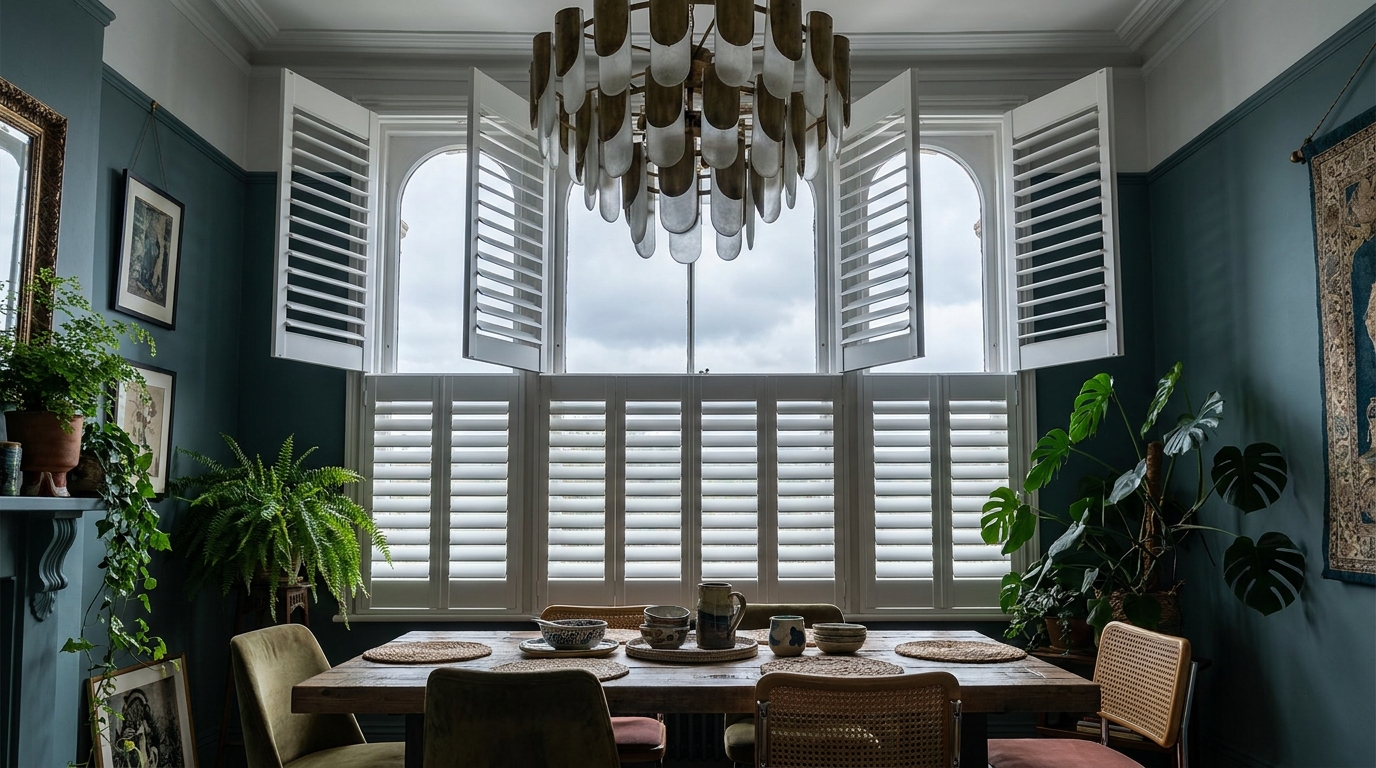
Shutters win on control and durability. A hardwood or engineered-composite louver at 3 1/2 or 4 1/2 inches is a rigid, opaque panel. Closed, it stops the beam completely. Tilted, it lets you dial in light and privacy at the same time — which is the reason they are so common on close-set lots in Sherman Oaks, Studio City, North Hollywood, and Toluca Lake, where the neighbor's window is 15 feet away. They also do not fade, sag, or curl in a room that gets baked every afternoon, which is more than you can say for some fabrics.
Shutters lose on two counts. First, they are an all-or-nothing device for heat. To block the low western sun you have to close them, and a closed shutter is a wall. You lose the view, and the room goes dim at 4pm on a July afternoon. Second, they are not an insulator. Wood is a better insulator than glass, but a shutter panel does not seal the opening — there are gaps at the louver seams, at the frame, and at the panel edges where the panels meet, and air moves through them.
A cellular (honeycomb) shade does the opposite. It is a poor privacy and view-control device compared to a shutter, but the trapped air in the cells is real insulation, and when it is mounted tight inside the opening it interrupts that convection loop far better than louvers do. On a bedroom window whose only job is to be dark and cool, cellular is the stronger heat answer.
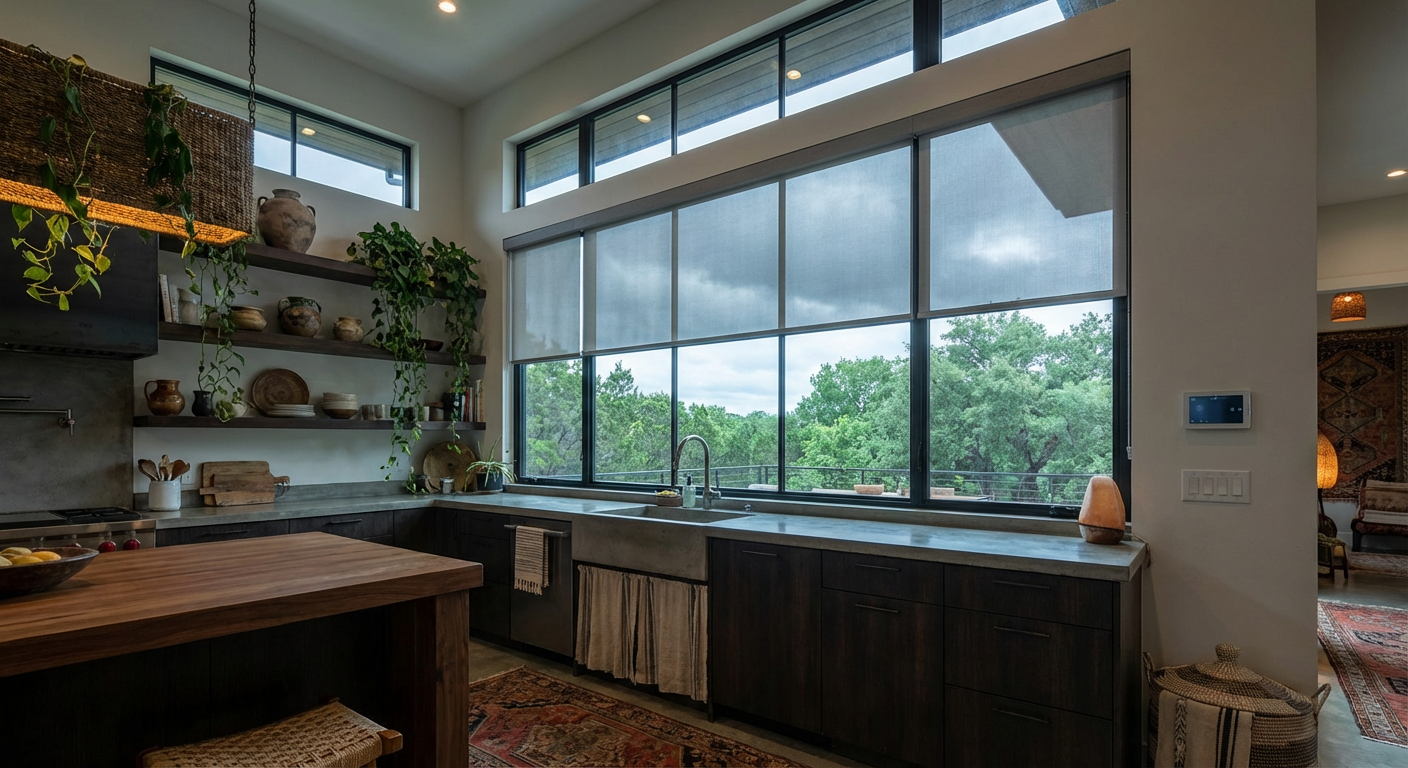
A solar shade is the third option and the one people underestimate. A 3 or 5 percent openness fabric cuts glare and blocks most of the direct beam while you keep the view — the thing shutters cannot do. Fabric color matters more than most reps explain: a light or pearl-backed fabric reflects heat back out through the glass, while the dark charcoal fabric everyone wants for the crisp view absorbs it and re-radiates inward. Dark fabric, better view, warmer room. That trade is worth understanding before you pick a swatch.
Louver angle, air gap, and mount: the details that change the temperature
Louver angle. When the sun is high — a south window at noon — tilting louvers so the outside edge points down deflects the beam toward the floor near the window and still lets diffuse light in. Tilting them up bounces light onto the ceiling for a softer room. But at 5pm on a west window the sun is coming in nearly horizontally, and there is no clever angle. You close them, or you let the sun in. Anyone who tells you a tilt setting solves western afternoon heat has not stood in one of these rooms.
Divider rails. A divider rail lets the top and bottom halves tilt independently. Great for privacy: close the bottom, open the top. Less useful for heat on a west window, because low sun comes through the top half. Order the rail for the view and the privacy, not for the cooling.
Air gap and mount. An inside-mount shutter needs roughly 2 1/2 to 3 1/2 inches of depth depending on louver size and frame style. Mounted inside, the panel sits back in the opening with a pocket of still air between it and the glass, and still air is insulation. Mounted outside on a build-out frame — which is what happens when the opening is too shallow, common on older valley homes with narrow window returns — the panel sits proud of the wall and that pocket becomes part of the room. Same product, slightly worse thermal behavior. Shades follow the same logic: an inside-mount shade with minimal side gaps traps air; an outside-mount shade hanging in front of the wall does not.
Sliders. Big west-facing sliders are where the valley's heat problem lives. Shutters on a slider are bypass or bifold panels on a track, and tracks leave gaps at the head and sill. It works, it looks right, and it will leak more air than a well-fitted shade in the same opening.
What this costs, and what we would actually put on a hot west wall
Plantation shutters run $55 to $95 per square foot installed, with a 12 square foot minimum billable per opening — so a small bathroom window is priced as if it were 12 feet. Roller, solar, zebra, and cellular shades run $495 to $955 per window installed on a typical window. Motorization adds $200 to $500 per window, which is not a luxury on a two-story view wall where the top row is unreachable and only ever gets closed if a remote or a schedule does it. Install is included in every price we quote, not billed after.
Room by room, this is how we usually land:
- West-facing living room with a view you paid for. A light-backed solar shade for the afternoon, so you keep the view and lose the glare. Shutters here mean closing the view every day at 4pm.
- Bedrooms. Cellular or a blackout roller in side channels. Dark, cooler, and cheaper than shutters on the same opening.
- Front rooms, dining rooms, anywhere the neighbors are close. Shutters. Nothing else gives you privacy and light in the same motion, and they read as architecture rather than as a window covering.
- The worst wall in the house. Layer. A solar or cellular shade on the glass with shutters or drapery outside it. Two treatments, two jobs — glare and view during the day, full closure when it is 104 in Chatsworth.
If you are weighing quotes that mix these products, dimensions and fabric names are what make them comparable — our line-by-line quote checklist walks through it, and why two similar roller shades price so differently covers the fabric side.
Heat is a room-by-room problem, and it is hard to solve from a catalog. Book a visit with 818 Shutters & Shades and someone comes to the home, measures every window, brings real samples you can hold up against the actual afternoon light, and leaves you with a firm quote. The in-home measure fee is $150 and it is credited toward your order. Book a measure and quote, or send sizes and photos if you would rather start remotely.
Frequently asked questions
Do plantation shutters keep a room cooler than roller shades?
Closed shutters and an opaque roller shade both stop the direct sun, which is most of the heat on a west window. On pure heat gain, a cellular shade or a light-backed solar shade mounted tight inside the opening usually does slightly better, because it interrupts the air movement at the glass more effectively than louvers do. Shutters win on privacy, light control, and durability in a room that gets baked every afternoon.
Does the louver angle matter for blocking heat?
It matters for high sun and barely at all for low sun. On a south-facing window at midday, tilting the louvers so the outside edge points down deflects the beam and still lets in diffuse light. On a west-facing window at 5pm the sun is nearly horizontal, so there is no tilt that blocks it — you close the panels or you let it in.
Is inside mount or outside mount better for heat?
Inside mount, when the opening is deep enough. An inside-mount panel sits back in the opening and leaves a pocket of still air between it and the glass, which acts as insulation. An outside-mount shutter on a build-out frame, common on older valley homes with shallow window returns, puts that air pocket inside the room instead.
How much do plantation shutters cost installed?
Plantation shutters run $55 to $95 per square foot installed, with a 12 square foot minimum billable per opening, so small windows price higher per foot. Installation is included in the quoted price. Roller, solar, zebra, and cellular shades run $495 to $955 per window installed on a typical window, and motorization adds $200 to $500 per window.
Should I put shades and shutters on the same window?
On the worst west-facing wall in the house, often yes. A solar or cellular shade on the glass handles glare and heat during the day while you keep some view, and shutters or lined drapery outside it give you full closure and privacy when you want the room shut down. It is two products doing two different jobs rather than one product compromising on both.
Ready to See Your Options?
- Remote quote from your sizes and photos
- See real samples in your space
- $150 in-home measure, credited to your order